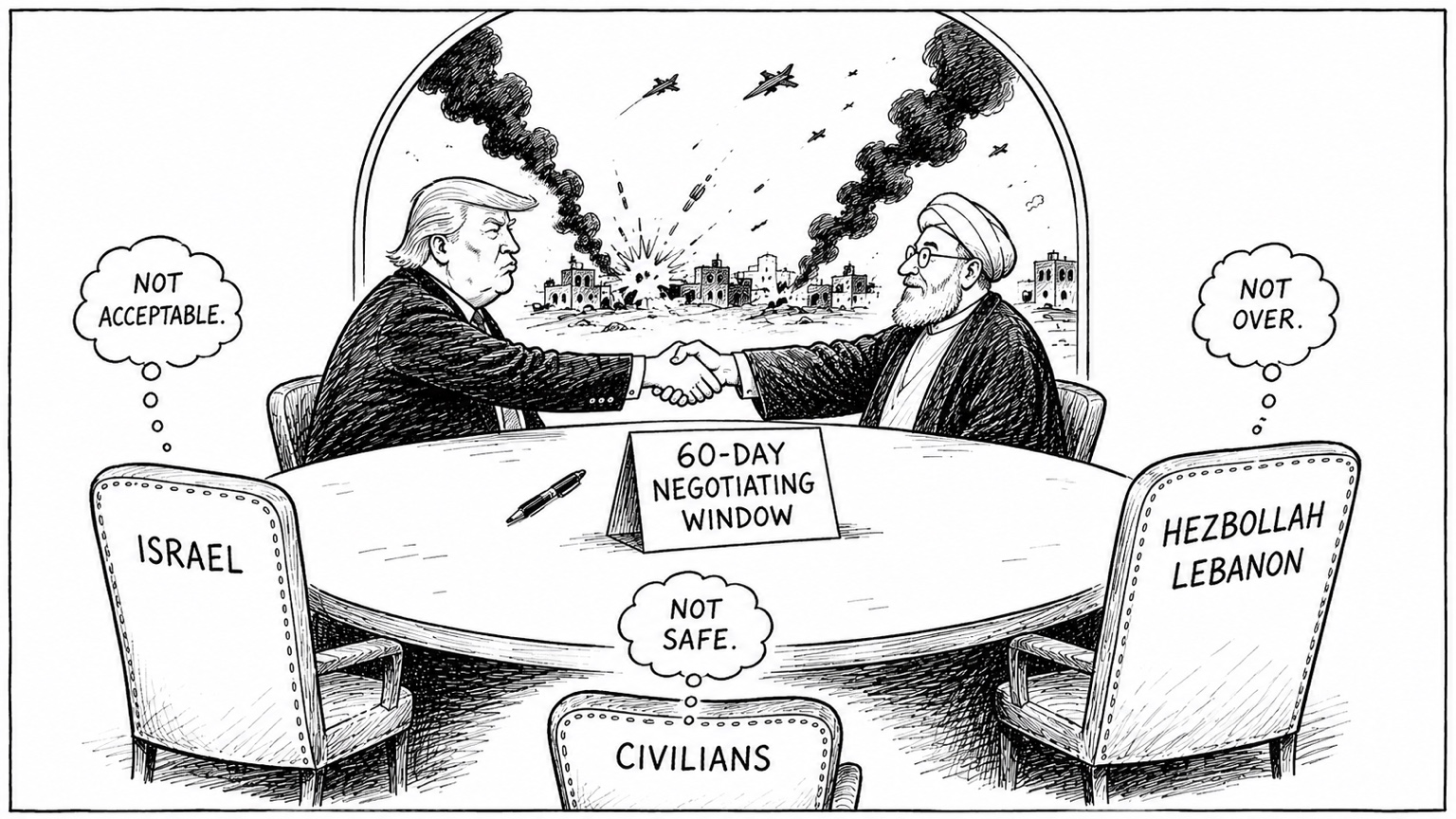
A memorandum of understanding signed by Washington and Tehran on Wednesday has launched a sixty-day negotiating period intended to end months of conflict. Within twenty-four hours of signing, planned peace talks in Switzerland had been cancelled, Israeli strikes had killed people in southern Lebanon, and the US Vice President was publicly rebuking an allied government. The agreement exists, but the conditions surrounding it are turbulent.
Where Sources Agree
All three sources confirm the core architecture of the moment. The US and Iran signed an MoU that initiates a ceasefire and a sixty-day window for a final deal. As part of the agreement, Washington lifted its naval blockade of Iranian ports. JD Vance defended the deal publicly, and planned follow-on talks in Burgenstock, Switzerland, were cancelled — a fact confirmed by Swiss authorities. The sources also agree that Israeli officials within Netanyahu's government criticised the agreement, and that Vance responded with unusual sharpness, reportedly warning that Israel "can't just kill your way out of solving every problem" and that America remains Israel's only powerful ally.
Where Sources Diverge
The differences between the three outlets are less about contested facts than about which facts each chose to place at the centre of the story.
Al Jazeera devotes substantial attention to events in Lebanon, reporting that Israeli strikes killed at least three people overnight — including two near Kfar Tebnit and one in Zabadin — a day after the MoU called for an end to military operations on all fronts. It also gives prominent space to Iranian voices, including statements framing the agreement as a form of victory and the "shattering" of adversarial dominance. Hezbollah's claim to have repelled a four-day Israeli offensive is included. The effect is a portrait of an agreement operating alongside ongoing conflict, with Iranian actors presented as confident claimants of the outcome.
The Times of Israel focuses on the diplomatic friction between Washington and Jerusalem, leading with Vance's criticism of what it characterises as an Israeli "freakout" and Trump's suggestion that Israel is poorly positioned to object given its behaviour during an earlier strategic moment. The Israeli strikes in Lebanon are acknowledged, though the framing centres on political confrontation rather than the humanitarian dimension. Iranian parliamentary statements and the Tasnim agency's reports on implementation conditions are largely absent.
Al Arabiya English concentrates almost entirely on Vance's rebuke of Israeli officials, presenting the Vice President as the article's protagonist and Israeli ministers as the antagonists. The outlet describes Vance as "visibly angered" and uses the word "diatribe" in its own reporting voice — language that carries evaluative weight. Notably, the Israeli strikes in southern Lebanon and their casualties do not appear. Nor do Iranian parliamentary warnings or Hezbollah's military activities. A reader relying solely on Al Arabiya English would encounter a story primarily about American impatience with Israeli ingratitude, with the MoU as backdrop rather than subject.
Considered Synthesis
The annotations accompanying these sources suggest the divergence is largely architectural: the outlets broadly agree on the existence of the MoU and its immediate complications, but they have constructed strikingly different stories from the same raw material. Geographic proximity shapes editorial focus — a regional outlet with strong ties to the Gulf will naturally emphasise the diplomatic confrontation between Washington and Tel Aviv, while a pan-Arab outlet with Iranian source networks will foreground Iranian voices and Lebanese casualties.
What emerges, when the three accounts are read together, is a picture of considerable complexity. An agreement has been signed, but its implementation is already under strain: Iranian negotiators were withholding confirmation of travel to Switzerland, pending evidence that the ceasefire was actually holding. It was not holding, at least not in Lebanon, where strikes continued. Meanwhile, a public rupture between Washington and its closest Middle Eastern ally unfolded in parallel.
The supplied sources do not address whether the sixty-day negotiating period is likely to succeed, nor do they provide independent verification of the competing claims made by Hezbollah and Israel regarding the Lebanese front. What the reporting does establish is that the gap between signing an agreement and implementing it can be substantial — and that the first twenty-four hours offered limited reassurance on that score.
Confidence Level: Medium. The core facts are consistent across sources, but significant omissions in individual outlets — particularly the absence of Lebanese civilian casualties from Al Arabiya English's account — mean that no single source provides a complete picture. The overall reporting landscape is coherent but incomplete.